



WORDS: JOANNA BANKS
The stars aligned for the production of How to Be a Latin Lover, thanks to California’s new tax credit initiatives to encourage more filming in the state. Not only did the Pantelion Films/Lionsgate production, released April 28, put its crew to work in Los Angeles, the production hosted three high school teachers on set as part of the career readiness component of the economic stimulus initiatives established by AB 1839 for the Film & Television Tax Credit Program 2.0, administered by the California Film Commission.
With How to Be a Latin Lover, studio executives knew they wanted to give the production an LA look, but initially considered other locations because of cost. “I did three budgets: One for LA, one for Georgia and one for Vancouver,” says Executive Producer Mike Upton. “[The studio] shot in LA because they got the tax credit.”
The state’s hundreds of millions of dollars in tax credits helped bring the How to Be a Latin Lover production to the region, boosting the local economy by employing a cast and crew within LA County. An important aspect of increasing film and television production in California and bringing jobs and tax revenue to the state is the career-based learning and training program required for projects that apply for tax credit incentives provided in the legislation. The requirement asks film and television producers to choose from options to engage the next generation of creative minds through set or post-production internships, teacher externships, classroom workshops, studio employment and professional skills tours for high school or community college students, or donating money to an educational purpose.
Film projects that may apply for tax credits include non-independent feature films and independent films. Applicants compete for funds with comparable projects, and tax credits are awarded after each project completes post-production, verifies that in-state jobs were created, and provides all required documentations, including audited cost reports.
In addition to films, tax credits target television production with pilots shot in California, new TV series, recurring TV series and relocating TV series. According to the Commission, in just two years under Program 2.0, California has attracted or retained 100 film and television projects generating an estimated $3.7 billion in direct spending to the state ‐including $1.4 billion in below‐the‐line wages.
“Even in high school, I worked as a photographer’s assistant in a work study program to look at what photographers do,” Upton says. “I’ve found that just by volunteering and getting involved, it opened doors for me. I valued that experience greatly as my career developed. It’s just a way of kind of giving back because I’ve found so much value in it myself.”
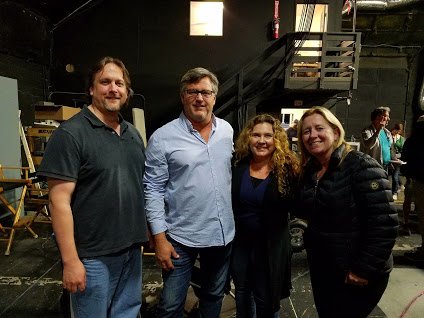
Cunneen, who spent two days on the set of How to Be a Latin Lover with Peterson, says Upton introduced the teachers to the head of every department on set, and she learned about nearly every aspect of the production, from the publicists running social media for actors to the carpenters building sets. “It was phenomenal just to be able to bring that knowledge back to our classroom — all the different types of jobs that are available for students to work in that industry.”
Adds Peterson, “It’s one thing to teach digital media, but it’s another to hang out on a set all day long. … It really gets the teacher fired up to discuss what’s happening out there in the industry.”
Peterson took part in a second faculty externship in January on the set of the Netflix original film, Bright, coordinated by Sean Glumace, K-14 Career Pathways Statewide Technical Assistance Provider, Doing What Matters for Jobs and the Economy, California Community Colleges. On the set of Bright, Peterson talked to an optometrist and learned that the professional had been hired to change and care for the contact lenses going into actors’ eyes.
“With the Bright production, from 1:30 p.m. to 9:30 at night, it gave us access to people that quite honestly probably don’t have time for us – the producers and the production team,” says Glumace. “It gave us a forum to ask questions we wouldn’t be able to ask in another setting.
“There’s this insider stuff that unless you’re there all the time, you’ll never see,” Glumace adds. “It’s theory vs. practice.” Career options in the creative economy are expansive, but not always obvious. “It’s not just about, ‘Oh, my student wants to be a camera person or my kid wants to be an editor. They built an apartment complex, they dug a hole and put in a pool. Those trades are there, HVAC, lighting, electrical, carpentry. I think as educators we’re not exposed to that enough. You become very good at what you teach, but there’s all this other stuff you didn’t realize existed on a film set.”
How to Be a Latin Lover stars Eugenio Derbez, Salma Hayek, Rob Lowe, Kristen Bell, Raquel Welch, Rob Corddry and Rob Riggle. Derbez produced with partner Benjamin Odell through 3Pas Studios.
On Twitter @HowToBeALatinLover; Instagram @HowToBeALatinLover; and hashtag #HowToBeALatinLover. www.PantelionFilms.com
Educators interested in participating in the tax credit’s career-based learning component, contact Nancy.Stone@film.ca.gov. Please include name, email and cell number, as well as school name and address, teaching focus, preferred method of participation and areas of interest.
 1989: I applied for a full-time summer job at the
 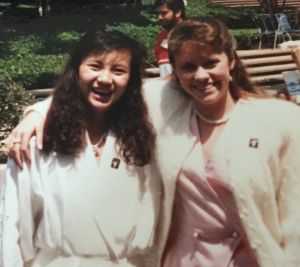 The Encounter days were a big deal. Vice President Dan Quayle came to JPL to speak and commemorate this huge accomplishment for JPL. Entertainers like Sidney Poitier and Woody Harrelson were invited and came to the celebration. After my full-time summer job ended with the Legislative Affairs Office, my contact in human resources at JPL asked if I wanted to continue working during the school year. I said yes and she found me a part-time position working for the Mechanical Systems Division. This was my senior year of high school. Every day after school, I went to work at JPL where my job was to support the administrative staff by making copies, answering the phone, and delivering time sensitive documents across the lab. Even though, I was part-time and still in high school, my supervisor gave me regular performance reviews and we had meaningful conversations about my five-year plan. The Section Manager gave everyone a pound of See’s Candies during the holidays and I was amazed he took time to deliver one to me. After high school, I went to Pasadena City College (PCC) full-time and continued working at JPL part-time. JPL encouraged people to grow and change roles within the organization. I wanted to learn and do more so was able to find a job with the Communications group. I wrote phone orders for when JPLers needed new phones or moved to different offices. This was also during JPL’s transition from analog to digital phones and the lab was replacing answering machines with voicemail so I wrote orders for those features and helped train rocket scientists (literally) on using their new phone systems. Plus, when JPL operators took lunch breaks, I stepped in to answer calls from the general public and transferred them to the appropriate people at JPL. After one year at PCC, I transferred to attend Claremont McKenna College (CMC) and my supervisor in the Communications group let me work on weekends so I had steady income my first year at CMC.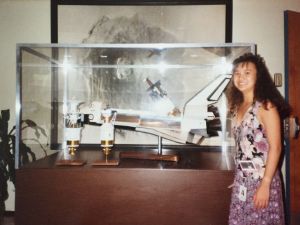
 To put it in current education-ese, I had a paid summer internship at JPL in 1989 and it continued for the next five years. Yes, I made a lot of copies and did many low-skill tasks along the way. But, it made me extremely empathetic to others I’ve asked to do those same tasks. JPL also taught me about how to treat people especially when times are tough. I remember when Mars Observer was lost and there were big banners at the lab that read, “MO Phone Home.” Budgets were being slashed and some people received lay-off notices. The people I met with lay-off notices were helped by the human resources folks with reassignments to different groups and offered retraining for different jobs based on their skill sets. Because of my JPL experience, I am a big advocate of young people having access to internships or other work experiences (internships are included in a grant proposal I’m working on now). I have hired summer interns who stayed on to work well past the summers. I now understand how my ‘internship’ at JPL left lasting impressions on me and was an integral part of my life journey. That is why I love and appreciate JPL! Thanks for reading.

